


A sentence becomesa working workforce.
Describe the procedure in your own words — a return, a refund, an order that needs a second look. Get a workforce you can edit, run, and pause for a human.
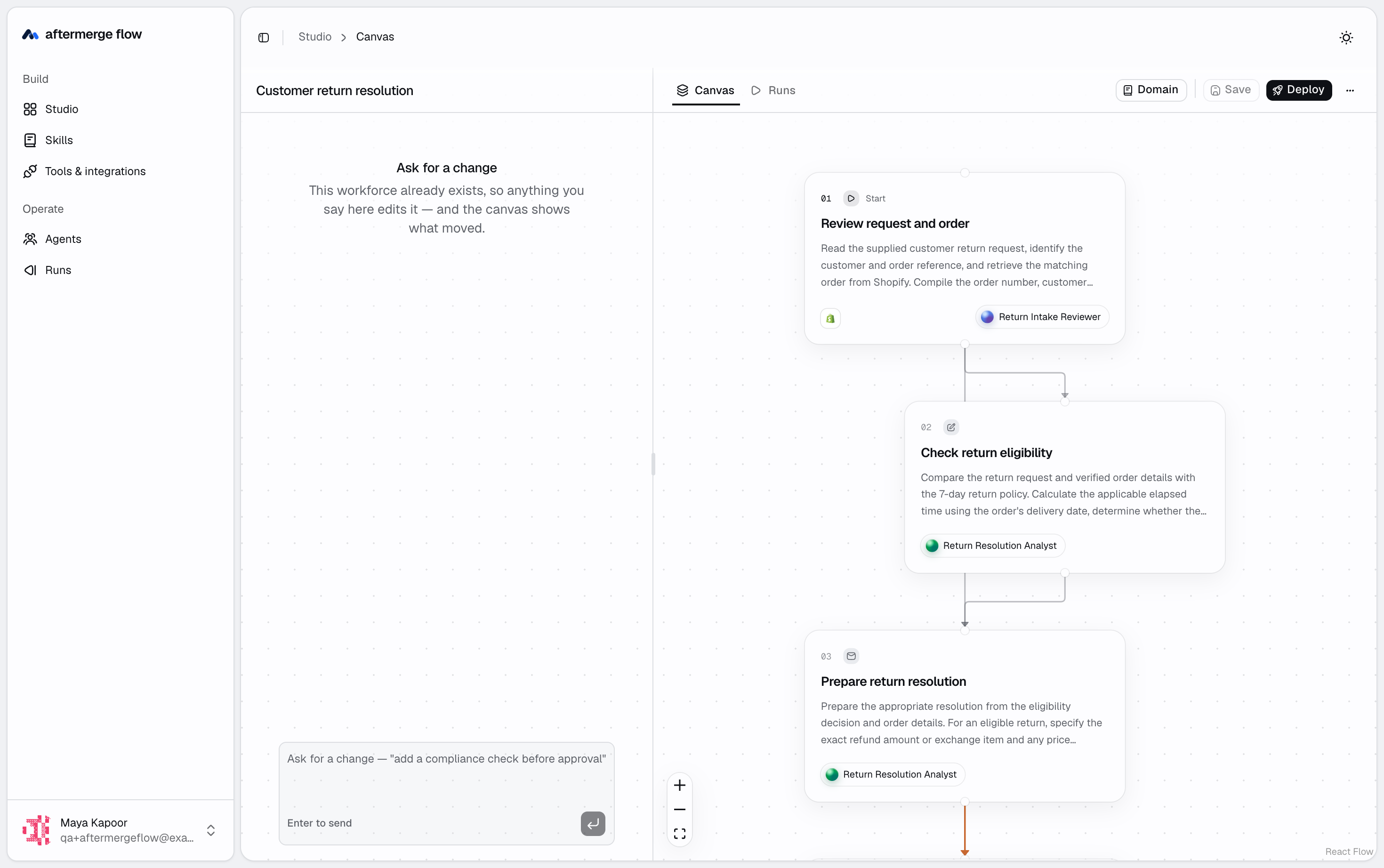
The person who knows the procedure cannot build the automation. The person who can build it does not know the procedure.
So stop transferring the knowledge. Write the procedure down in your own steps and your own thresholds — a return window, a refund limit — and keep a person in the loop wherever it said one was required.
You describe the procedure. You get a plan back.
“When a customer asks for a return, check the order against our policy and refund small amounts on its own.” At most two clarifying questions, then a plan in plain English. Nothing is built until you say yes.
- Read what you need6.8s
- Checked the skill library1.9s
- 1Read the return requestPull up the order — items, price, cash on delivery or prepaid, delivery date — alongside the customer's reason and photos.
- 2Check it against your return policyThe 7-day window, non-returnable categories, item condition, and how often this customer has returned before.
- 3Prepare the resolutionDraft the refund, exchange or store credit and book the reverse pickup, without sending any money.
- 4Ask before a big refundAnything over ₹3,000, or with a policy flag, waits for the support lead to approve before any money moves.
Roles become workers. Steps become work.
The graph is the workforce, and you can still edit it. A run honours what you see, not a prompt you cannot inspect.
Each role from the SOP is a named worker.
Returns intake. Policy analyst. Refund coordinator. Not a blank agent you have to prompt. The procedure already said who does what.
- Returns Intake Specialist
- Returns Policy Analyst
- Refund & Resolution Coordinator
Returns Intake Specialist
Read return request
Read the customer's return request, pull up the order — items, price, payment mode, delivery date — and attach the phot…
Returns Policy Analyst
Check return policy
Check the case against the return policy: the 7-day window, non-returnable categories, item condition, COD or prepaid, …
Refund & Resolution Coordinator
Prepare resolution
Prepare the refund, exchange or store credit and book the reverse pickup. Do not send any money yet.
Returns Policy Analyst
Approve refund
Refunds over the ₹3,000 auto-refund limit, or with any policy flag, go to the support lead to approve or reject.
Refund & Resolution Coordinator
Refund and notify
Issue the approved refund, update the order and tell the customer when to expect the money.
Where a person had to decide, the work stops and asks.
A refund over the limit, a customer who returns everything, a cash-on-delivery order that looks wrong. You approve or you reject, and the same run continues. Same id, same trace, the decision on the record.
Approve this refund? It is over the auto-refund limit and has one policy flag.
Order #10482 — linen co-ord set, ₹4,299, prepaid. Delivered 3 days ago, inside the 7-day window; photos show a torn seam, so the item qualifies. Refund is over the ₹3,000 auto-refund limit, and this customer has returned 4 of their last 6 orders.
Paused is not failed. Nothing is lost while it waits.
Sign in once for the org.
Your store, your payments, your inbox and the rest of the catalogue. Every workforce can use the actions. A connection is not owned by a single agent.
Kick off a run from the tools you already have.
A webhook when a return is requested. A channel message when a refund needs a yes. An email when the day's returns are done.